

FAQs for AI Search: How to Write Answers AI Can Cite
Learn how to write FAQs that AI search tools understand and cite: structure, ideal length, placement, schema myths and examples for 2026.
 admin
admin
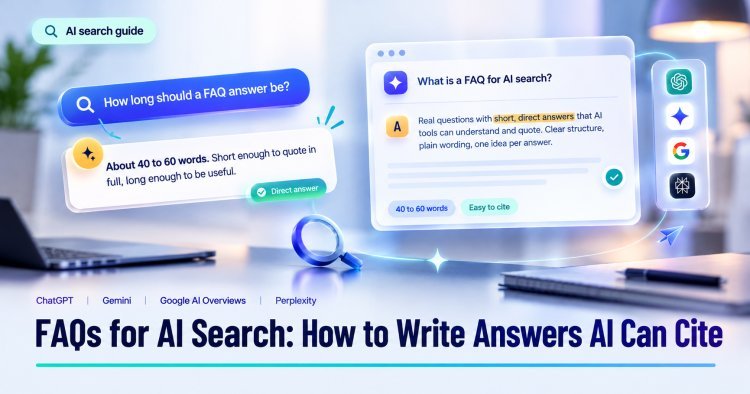

Quick Answer (TL;DR)
Write FAQs the way real people ask questions, and put the answer in the first sentence. Keep each answer to roughly 40 to 60 words, place the section high on the page, and cover the wider topic instead of only your product. FAQ schema is optional. The Q&A content matters far more than the markup.
Why FAQs Fit AI Search So Well
When someone asks ChatGPT, Gemini or Google a question, the tool wants a clear answer to lift out and use. A FAQ is already built that way: one question, one answer, a little context.
Chat-style queries are almost always phrased as questions, so a good FAQ gives AI systems a ready-made library of questions with direct answers. This is also why FAQs matter for GEO, AEO and AIO, which are different names for the same job: making your content easy for AI systems to find, understand and use.
Google itself says that optimizing for generative AI search is still, at heart, optimizing for the search experience. So this is not a replacement for SEO. It is SEO with sharper writing.
What a Good AI-Ready FAQ Looks Like
A strong FAQ entry has three parts:
- The question, in the words a real person would type into an AI tool
- A direct answer in the first sentence, with no warm-up
- One line of context, such as a condition, an example or a number
Weak: "How can our industry-leading platform transform your workflow?"
Strong: "How do I choose an AI coding tool for a small team?"
The weak version is marketing copy. The strong one is a question someone would genuinely ask.
How Long Should FAQ Answers Be?
Short enough to quote whole, long enough to be useful. One 2026 guide puts the sweet spot at 40 to 60 words. Treat that as a practical guideline, not an official rule. Some questions need two or three sentences more.
Example answer (about 50 words):
How do I make a FAQ show up in AI answers?
Write the question the way people actually ask it, then answer it in the first sentence. Add one line of context, keep the whole answer under about 60 words, and place the FAQ where crawlers and readers see it early. Clear, helpful content matters more than any markup.
Where to Place Your FAQs
Do not bury them in the footer or hide them behind a link that only opens a PDF. Put the section where people and crawlers reach it early, and keep it as normal HTML text on the page. If you have a separate FAQ page, link to it clearly, but make sure it is easy to crawl and genuinely useful, not just promotional.
Write for the Topic, Not Just Your Brand
AI answers draw on many sources at once. FAQs that teach the wider topic ("what is it, how does it work, how do I choose") are more useful to both readers and AI than FAQs that only repeat your product name. Add brand-specific questions too, but lead with the questions people have before they know your brand.
Do You Need FAQ Schema? What the Evidence Says
This is where advice conflicts, so be careful.
- Google's position: According to its first dedicated generative AI search guide, published on May 15, 2026, structured data is not required for AI Overviews or AI Mode, and no special markup is needed.
- Independent data: A May 2026 study reported by Search Engine Journal found that adding JSON-LD schema did not measurably increase AI citations for pages already visible in AI Overviews.
- Vendor claims: Some SEO tools claim FAQ schema makes pages 3.2 times more likely to appear in AI Overviews. Treat figures like this cautiously, because they come from companies selling optimization services and conflict with Google's own guidance.
A sensible approach: If you already use FAQPage schema, keep it, since it does no harm. If you do not, do not expect it to be a magic lever. Spend your time on the quality of the questions and answers.
Common FAQ Mistakes That Hurt AI Visibility
- Treating it as an SEO checkbox: Stuffed keywords and repeated product names make FAQs sound robotic.
- Generic questions: "What is quality?" helps nobody.
- Internal jargon: Use customers' words, not your team's shorthand.
- Burying the answer: Do not start with three sentences of background.
- Letting it go stale: Out-of-date prices, dates or features make a FAQ untrustworthy.
- Copying competitors: Original, experience-based answers stand out.
Will FAQs Reduce Your Traffic?
They may reduce casual, low-intent clicks, because AI tools can answer simple questions directly. But when your content is used for a complex answer, the people who do click through tend to be further along in their decision. Aim for quality of visitor, not just volume.
FAQ Writing Checklist
- Each question matches how a real person would phrase it
- The first sentence answers it directly
- Answers are roughly 40 to 60 words where possible
- The section sits high on the page, in plain HTML
- Questions cover the topic, not only your product
- Facts, dates and prices are current
- Schema is added if easy, but not relied on
Frequently Asked Questions
What is a FAQ for AI search?
It is a set of real questions with short, direct answers written so AI tools can understand and quote them. It works like a normal FAQ, but with plainer wording, clearer structure and answers that stand on their own.
Are GEO, AEO and AIO the same thing?
Mostly, yes. They are overlapping names for improving how AI systems find, understand and cite your content. Different people use different labels, but the practical work is similar.
How long should a FAQ answer be?
About 40 to 60 words is a good target. That is long enough to be useful and short enough to be quoted in full. Complex questions can run longer.
Do I need FAQ schema to appear in AI Overviews?
No. Google says structured data is not required for AI Overviews or AI Mode. Keep schema if you have it, but focus on clear content.
Where should I put the FAQ section?
High enough on the page that readers and crawlers find it easily, as normal HTML text rather than a PDF or hidden panel.
Can FAQs help even if AI does not cite my brand?
Possibly. AI systems combine many sources, so clear, accurate answers can shape how a topic is explained even without a direct mention. Treat that as a possible benefit, not a guarantee.
Conclusion
AI search rewards content that answers real questions clearly. Write like a helpful person, answer first, keep it short, and keep it accurate. Start by rewriting your top five FAQs this week, then expand.