
Why Your Website Is Losing Traffic to AI Search — And Exactly What to Do About It
Your website traffic is dropping — and AI search is why. This guide explains exactly what is happening to organic traffic and gives you a clear practical strategy to get your business visible on Google, ChatGPT and Perplexity right now.
 admin
admin

Introduction
This blog covers why websites across every industry are losing organic traffic to AI-powered search in 2026 — and exactly what businesses must do to stay visible. You will learn the difference between SEO, GEO, and AEO, why traditional strategies alone are no longer enough, and the practical steps to make your business show up on Google, ChatGPT, Perplexity, and every major AI search tool right now.
Something changed. And most businesses have not figured out what yet.
Your content is still live. Your SEO is still set up. You are still publishing consistently. But your website traffic? It is quietly going down — and nobody on your team can explain exactly why.
Here is the honest answer.
AI ate it.
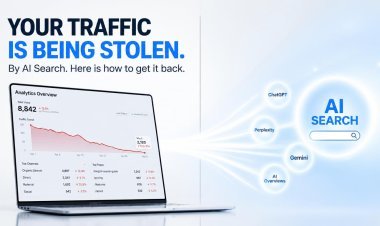
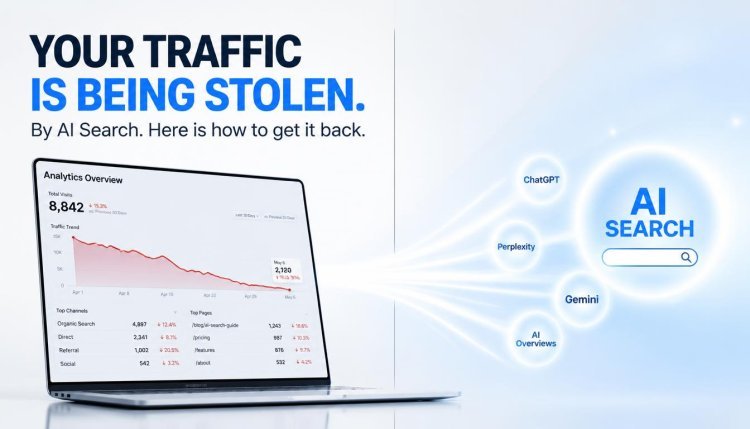
Not dramatically. Not overnight. But gradually and consistently, the way people search for information has shifted — and the traffic that used to land on your website is now being answered directly by AI tools before the user ever clicks a link.
This is not a panic-worthy crisis. But it is a real shift that requires a real response. And this guide is going to give you that response — clearly, practically, and without the jargon.
Let us start with what is actually happening.
What Is Actually Happening to Your Traffic
When someone used to search "best digital marketing strategy for small business" on Google, they got a list of links. They clicked one. That was your traffic opportunity.
Now, Google's AI Overview answers that question directly on the search results page — pulling from multiple sources and summarising the answer — before the user ever sees your link.
The same thing is happening on ChatGPT, Perplexity, Gemini, and Claude. Millions of people are typing their questions into these tools and getting complete answers instantly. No click required. No website visit. No traffic for you.
According to EMARKETER, approximately 31.3% of the US population now uses generative AI search tools regularly in 2026. That number is growing every month. And with it, the traditional model of SEO-driven organic traffic is under genuine pressure.
Studies show that while AI search sends less overall traffic volume, the traffic it does send converts at significantly higher rates — with some B2B reports showing AI-referred visitors influencing up to 9.7% of total revenue despite lower click volumes.
What this means practically is simple. The game has not ended. It has changed. And the businesses adapting right now are the ones that will own the next three to five years of digital visibility.
Here is how to adapt.
Step 1 — Understand the Three Layers of Modern Search Visibility
In 2026, getting found online requires optimising for three things simultaneously — not just one.
SEO — Search Engine Optimisation
This is what you already know. Ranking on Google's traditional blue links. It still matters. According to HubSpot's 2026 State of Marketing report, more than 60% of surveyed marketers said it is easier to improve website visits now than it was ten years ago. SEO is not dead. But it is no longer sufficient on its own.
AEO — Answer Engine Optimisation
This is about structuring your content so it gets pulled as a direct answer in Google's featured snippets, voice search results, and AI Overview boxes. When someone asks a specific question and Google answers it at the top of the page without sending them to a website — that answer came from somewhere. AEO is about making that somewhere be your website.
GEO — Generative Engine Optimisation
This is the newest and most important layer right now. GEO is the practice of optimising your content so that AI tools like ChatGPT, Perplexity, Gemini, and Claude cite your brand and content when users ask relevant questions.
According to TheeDigital's 2026 Digital Marketing Trends report, the new search landscape revolves entirely around GEO, AI citations, structured data, entity-rich topical depth, and platform-specific content designed for machine understanding.
The goal is no longer simply to rank number one on Google. The goal is to become a trusted source that AI systems understand, reference, and recommend.
For expert support building a digital marketing strategy that covers all three layers — SEO, AEO, and GEO — visit GG Consultancy where they help businesses build visibility across both traditional and AI-powered search.
Step 2 — Create Content That Humans Love and AI Can Actually Use
Here is where most businesses are making the biggest mistake right now.
They are producing more content — using AI tools to speed up output — without realising that generic, AI-generated content is the content that performs worst in AI search results.
Smart Insights reported in their 2026 Digital Marketing Trends analysis that there has been a huge increase in what the industry is now calling AI slop — generic, high-volume content that lacks genuine expertise, real experience, and original insight. And AI search systems are getting better at detecting and deprioritising exactly this kind of content.
What actually performs well in AI search is content that demonstrates three things — genuine expertise in the topic, real experience with the subject matter, and trustworthy sourcing that AI systems can verify and cite with confidence.
In practical terms, this means your content needs to:
Answer specific questions directly and clearly — not dance around the answer with lengthy preambles. AI systems pull the most direct, useful response they can find.
Include original data, real examples, and specific insights from your own experience or research. Content that adds something new to the conversation performs dramatically better than content that simply restates what already exists.
Be well structured with clear headings, concise paragraphs, and logical flow. According to multiple 2026 search studies, well-structured content performs dramatically better in AI Overview inclusion tests than dense, unstructured text.
Use natural language that matches how real people ask questions — because AI search is built on understanding conversational intent, not just keyword matching.
Step 3 — Build Topical Authority, Not Just Individual Pages
This is one of the most significant shifts in how search works in 2026 — and most businesses are still optimising the old way.
Traditional SEO thinking was about individual pages. Write a page targeting a keyword. Build some links to it. Hope it ranks.
Modern search — both traditional and AI — evaluates your entire content ecosystem. It looks at whether your website demonstrates comprehensive, deep, consistent expertise across a specific topic area. Brands creating what are called content clusters — a central pillar page covering a broad topic supported by multiple detailed pages covering every related subtopic — are seeing significantly better performance in both Google and AI search results.
WebFX's 2026 Digital Marketing Trends report makes this point clearly: AI platforms are rewarding interconnected content that builds topical authority rather than isolated individual pieces. The shift is from "I have one great page about this topic" to "I have the most comprehensive, trustworthy body of content about this topic anywhere online."
This is a longer-term investment. But it compounds powerfully. Once you establish genuine topical authority in your niche, AI systems begin defaulting to your content as a trusted source — and that visibility is extremely difficult for competitors to displace.
Step 4 — Optimise for Middle of Funnel, Not Just Top of Funnel
Here is a practical insight that is changing content strategy for smart businesses right now.
Top of funnel informational content — the "what is" and "how does" questions — is increasingly being answered entirely by AI without sending traffic to websites. This is where the traffic loss is most visible and most severe.
But middle of funnel content — content that speaks to someone who already understands the basics and is now evaluating their options, comparing solutions, or getting close to making a decision — is still driving high-quality website visits and conversions.
According to research cited by WebFX in their 2026 trends analysis, winning digital marketing strategies right now are focused on persona-driven middle of funnel content that speaks directly to purchase drivers and user intent. This type of content captures higher-value clicks, attracts visitors who are closer to buying, and converts at higher rates than informational top of funnel traffic ever did.
In practical terms, this means creating content like detailed comparison guides, specific case studies, honest reviews of your own services versus alternatives, and content that addresses the exact questions someone asks right before they decide to buy.
Step 5 — Make Your Brand Visible Across Multiple Channels Simultaneously
One of the most important data points from Google's 2026 Digital Marketing Trends research is this — 83% of global consumers use Google and YouTube daily. That is a significantly higher percentage than any other online platform.
What this means is that your digital marketing cannot live only on your website. The businesses appearing consistently across multiple channels — their website, YouTube, LinkedIn, email newsletters, podcast appearances, and social media — are the ones being picked up and cited by AI systems across the board.
AI search tools do not just pull from websites. They pull from anywhere authoritative content exists. A well-produced YouTube video where you explain a concept clearly. A LinkedIn article where you share a genuine insight. A podcast episode where you discuss your area of expertise. All of these contribute to the overall picture of your brand's authority that AI systems are building and referencing.
Content Marketing Trends research published in September 2026 confirms this directly — content distribution in 2026 is moving beyond traditional search and blog publishing alone. Brands sharing content through AI search results, newsletters, short-form video, social platforms, and repurposed assets across many channels are outperforming brands that publish only to their website.
Your blog post needs to also become a short video, a LinkedIn article, an email newsletter, FAQ content, and social media posts. One piece of content. Multiple channels. Maximum visibility.
Step 6 — Focus on Trust Signals That AI Systems Actually Recognise
This is perhaps the least discussed but most important element of GEO strategy right now.
AI search systems do not just read your content. They evaluate whether your brand is trustworthy enough to cite. And they do this by looking at a specific set of trust signals that are different from traditional SEO ranking factors.
Being mentioned by other credible websites and publications in your industry. Having consistent, accurate information about your business across every platform it appears on. Receiving genuine reviews and testimonials that demonstrate real client experience. Publishing content that cites reputable external sources. Being associated with recognised experts in your field.
These signals collectively tell AI systems — this is a brand that real people trust, that other credible sources reference, and that has genuine expertise in this area. That assessment is what gets your brand cited in AI-generated answers.
According to igmGuru's 2026 Digital Marketing Trends analysis, the focus for businesses is shifting from ranking number one to becoming a trusted source that AI systems cite and summarise. The goal is entity authority — being recognised as a genuine expert in your specific niche by both human readers and the AI systems that increasingly mediate how people find information.
For businesses wanting expert support building this kind of authoritative digital presence and developing a strategy that works across SEO, GEO, and AEO simultaneously, GG Consultancy provides the strategic guidance and practical implementation support to make it happen.
The Honest Reality About This Transition
Here is what this shift does not mean.
It does not mean SEO is dead. It is not. It means SEO is necessary but no longer sufficient.
It does not mean your website is irrelevant. It is not. But its role is evolving — from being the only destination to being one of multiple touchpoints in a more complex discovery journey.
It does not mean you need to rebuild everything from scratch. You do not. Most of the work you have already done on your website and content is still valuable. It just needs to be extended and adapted for the new landscape.
What this transition does mean is that the businesses who act on this now — who start building GEO and AEO strategies alongside their existing SEO — will have a significant advantage over competitors who wait until the traffic loss becomes impossible to ignore.
The window to establish a strong position in AI search is still open. But industry analysts are consistent on this point — by the time it feels urgent, the dominant positions will already have been taken by businesses that moved earlier.
Final Thoughts
Your website traffic is not dropping because your content got worse. It is dropping because the way people find information changed — and your strategy has not caught up yet.
The fix is clear. Add AEO and GEO to your existing SEO foundation. Create content that demonstrates genuine expertise and answers real questions directly. Build topical authority across your niche. Show up consistently across multiple channels. Earn the trust signals that AI systems recognise and reward.
None of this is complicated. But all of it requires consistency, patience, and a willingness to think about digital marketing differently than you have before.
Start with one step. Pick the most important question your ideal customer is asking right now and create the best, clearest, most genuinely useful answer that exists anywhere online. Structure it well. Publish it. Then do it again.
That is how you win in AI search. Not with tricks. With trust.
Want expert help building a digital marketing strategy that makes your business visible on Google, ChatGPT, Perplexity, and every major AI search tool? Visit GG Consultancy and build a presence that compounds in value every single month.